1
2
3
4
5
6
7
8
9
10
11
12
13
14
15
16
17
18
19
20
21
22
23
24
25
26
27
28
29
30
31
32
33
34
35
36
37
38
39
40
41
42
43
44
45
46
47
48
49
50
51
52
53
54
55
56
57
58
59
60
61
62
63
64
65
66
67
68
69
70
71
72
73
74
75
76
77
78
79
80
81
82
83
84
85
86
87
88
89
90
91
92
93
94
95
96
97
98
99
100
101
102
103
104
105
106
107
108
109
110
111
112
113
114
115
116
117
118
119
120
121
122
123
124
125
126
127
128
129
130
131
132
133
134
135
136
137
138
139
140
141
142
143
144
145
146
147
148
149
150
151
152
153
154
155
156
157
158
159
160
161
162
163
164
165
166
167
168
169
170
171
172
173
174
175
176
177
178
179
180
181
182
183
184
185
186
187
188
189
190
191
192
193
194
195
196
197
198
199
200
201
202
203
204
205
206
207
208
209
210
211
212
213
214
215
216
217
218
219
220
221
222
223
224
225
226
227
228
229
230
231
232
233
234
235
236
237
238
239
240
241
242
243
244
245
246
247
248
249
250
251
252
253
254
255
256
257
258
259
260
261
262
263
264
265
266
267
268
269
270
271
272
273
274
275
276
277
278
279
280
281
282
283
284
285
286
287
288
289
290
291
292
293
294
295
296
297
298
299
300
301
302
303
304
305
306
307
308
309
310
311
312
313
314
315
316
317
318
319
320
321
322
323
324
325
326
327
328
329
330
331
332
333
334
335
336
337
338
339
340
341
342
343
344
345
346
347
348
349
350
351
352
353
354
355
356
357
358
359
360
361
362
363
364
365
366
367
368
369
370
371
372
373
374
375
376
377
378
379
380
381
382
383
384
385
386
387
388
389
390
391
392
393
394
395
396
397
398
399
400
401
402
403
404
405
406
407
408
409
410
411
412
413
414
415
416
417
418
419
420
|
# AIChat
[](https://github.com/sigoden/aichat/actions/workflows/ci.yaml)
[](https://crates.io/crates/aichat)
Use GPT-4(V), Gemini, LocalAI, Ollama and other LLMs in the terminal.
AIChat in chat REPL mode:

AIChat in command mode:

## Install
### Use a package management tool
For Rust programmer
```sh
cargo install aichat
```
For macOS Homebrew or a Linuxbrew user
```sh
brew install aichat
```
For Windows Scoop user
```sh
scoop install aichat
```
For Android termux user
```sh
pkg install aichat
```
### Binaries for macOS, Linux, Windows
Download it from [GitHub Releases](https://github.com/sigoden/aichat/releases), unzip and add aichat to your $PATH.
## Support LLMs
- OpenAI: gpt-3.5/gpt-4/gpt-4-vision
- Gemini: gemini-pro/gemini-pro-vision
- LocalAI: opensource LLMs and other openai-compatible LLMs
- Ollama: opensource LLMs
- VertexAI: gemini-pro/gemini-pro-vision/gemini-ultra/gemini-ultra-vision
- Azure-OpenAI: user deployed gpt-3.5/gpt-4
- Ernie: ernie-bot-turbo/ernie-bot/ernie-bot-8k/ernie-bot-4
- Qianwen: qwen-turbo/qwen-plus/qwen-max/qwen-max-longcontext/qwen-vl-plus
## Features
- Have two modes: [REPL](#chat-repl) and [Command](#command).
- Support [Roles](#roles)
- Support context-aware conversation (session)
- Support multimodal models (vision)
- Execute commands using natural language
- Syntax highlighting for markdown and 200+ languages in code blocks
- Stream output
- Use proxy
- With Dark/light theme
- Save messages/sessions
## Config
On first launch, aichat will guide you through the configuration.
```
> No config file, create a new one? Yes
> AI Platform: openai
> API Key: sk-xxxxxxxxxxxxxxxxxxxxxxxxxxxxxxxxxxxxxxxxxxxxxxxx
```
Feel free to adjust the configuration according to your needs.
```yaml
model: openai:gpt-3.5-turbo # LLM model
temperature: 1.0 # GPT temperature, between 0 and 2
save: true # Whether to save the message
highlight: true # Set false to turn highlight
light_theme: false # Whether to use a light theme
wrap: no # Specify the text-wrapping mode (no, auto, <max-width>)
wrap_code: false # Whether wrap code block
auto_copy: false # Automatically copy the last output to the clipboard
keybindings: emacs # REPL keybindings. values: emacs, vi
prelude: '' # Set a default role or session (role:<name>, session:<name>)
clients:
- type: openai
api_key: sk-xxx
- type: localai
api_base: http://localhost:8080/v1
models:
- name: gpt4all-j
max_tokens: 8192
```
Take a look at the [config.example.yaml](config.example.yaml) for the complete configuration details.
There are some configurations that can be set through environment variables. For more information, please refer to the [Environment Variables](https://github.com/sigoden/aichat/wiki/Environment-Variables) page.
### Roles
We can define a batch of roles in `roles.yaml`.
> We can get the location of `roles.yaml` through the repl's `.info` command or cli's `--info` option.
For example, we can define a role:
```yaml
- name: shell
prompt: >
I want you to act as a Linux shell expert.
I want you to answer only with bash code.
Do not provide explanations.
```
Let ChatGPT answer questions in the role of a Linux shell expert.
```
> .role shell
shell> extract encrypted zipfile app.zip to /tmp/app
mkdir /tmp/app
unzip -P PASSWORD app.zip -d /tmp/app
```
AIChat with roles will be a universal tool.
```
$ aichat --role shell extract encrypted zipfile app.zip to /tmp/app
unzip -P password app.zip -d /tmp/app
$ cat README.md | aichat --role spellcheck
```
For more details about roles, please visit [Role Guide](https://github.com/sigoden/aichat/wiki/Role-Guide).
## Chat REPL
aichat has a powerful Chat REPL.
The Chat REPL supports:
- Emacs/Vi keybinding
- [Custom REPL Prompt](https://github.com/sigoden/aichat/wiki/Custom-REPL-Prompt)
- Tab Completions
- Edit/paste multiline text
- Open an editor to modify the current prompt
- Undo support
### `.help` - print help message
```
> .help
.help Print this help message
.info Print system info
.model Switch LLM model
.role Use a role
.info role Show role info
.exit role Leave current role
.session Start a context-aware chat session
.info session Show session info
.exit session End the current session
.file Attach files to the message and then submit it
.set Modify the configuration parameters
.copy Copy the last reply to the clipboard
.exit Exit the REPL
Type ::: to begin multi-line editing, type ::: to end it.
Press Ctrl+O to open an editor to modify the current prompt.
Press Ctrl+C to abort readline, Ctrl+D to exit the REPL
```
### `.info` - view information
```
> .info
model openai:gpt-3.5-turbo
temperature -
dry_run false
save true
highlight true
light_theme false
wrap no
wrap_code false
auto_copy false
keybindings emacs
prelude -
config_file /home/alice/.config/aichat/config.yaml
roles_file /home/alice/.config/aichat/roles.yaml
messages_file /home/alice/.config/aichat/messages.md
sessions_dir /home/alice/.config/aichat/sessions
```
### `.model` - choose a model
```
> .model openai:gpt-4
> .model localai:gpt4all-j
```
> You can easily enter enter model name using autocomplete.
### `.role` - let the AI play a role
Select a role:
```
> .role emoji
```
Send message with the role:
```
emoji> hello
👋
```
Leave current role:
```
emoji> .exit role
> hello
Hello there! How can I assist you today?
```
Show role info:
```
emoji> .info role
name: emoji
prompt: I want you to translate the sentences I write into emojis. I will write the sentence, and you will express it with emojis. I just want you to express it with emojis. I don't want you to reply with anything but emoji. When I need to tell you something in English, I will do it by wrapping it in curly brackets like {like this}.
temperature: null
```
Temporarily use a role to send a message.
```
> ::: .role emoji
hello world
:::
👋🌍
>
```
### `.session` - context-aware conversation
By default, aichat behaves in a one-off request/response manner.
You should run aichat with `-s/--session` or use the `.session` command to start a session.
```
> .session
temp) 1 to 5, odd only 0
1, 3, 5
temp) to 7 19(0.46%)
1, 3, 5, 7
temp) .exit session 42(1.03%)
? Save session? (y/N)
```
The prompt on the right side is about the current usage of tokens and the proportion of tokens used,
compared to the maximum number of tokens allowed by the model.
### `.file` - attach files to the message
```
Usage: .file <file>... [-- text...]
.file message.txt
.file config.yaml -- convert to toml
.file a.jpg b.jpg -- What’s in these images?
.file https://ibb.co/a.png https://ibb.co/b.png -- what is the difference?
```
> Only the current model that supports vision can process images submitted through `.file` command.
### `.set` - modify the configuration temporarily
```
> .set temperature 1.2
> .set dry_run true
> .set highlight false
> .set save false
> .set auto_copy true
```
## Command
```
Usage: aichat [OPTIONS] [TEXT]...
Arguments:
[TEXT]... Input text
Options:
-m, --model <MODEL> Choose a LLM model
-r, --role <ROLE> Choose a role
-s, --session [<SESSION>] Create or reuse a session
-e, --execute Execute commands using natural language
-f, --file <FILE>... Attach files to the message to be sent
-H, --no-highlight Disable syntax highlighting
-S, --no-stream No stream output
-w, --wrap <WRAP> Specify the text-wrapping mode (no*, auto, <max-width>)
--light-theme Use light theme
--dry-run Run in dry run mode
--info Print related information
--list-models List all available models
--list-roles List all available roles
--list-sessions List all available sessions
-h, --help Print help
-V, --version Print version
```
Here are some practical examples:
```sh
aichat -s # Start REPL with a new temp session
aichat -s temp # Reuse temp session
aichat -r shell -s # Create a session with a role
aichat -m openai:gpt-4-32k -s # Create a session with a model
aichat -s sh unzip a file # Run session in command mode
aichat -r shell unzip a file # Use role in command mode
aichat -s shell unzip a file # Use session in command mode
cat config.json | aichat convert to yaml # Read stdin
cat config.json | aichat -r convert:yaml # Read stdin with a role
cat config.json | aichat -s i18n # Read stdin with a session
aichat --file a.png b.png -- diff images # Attach files
aichat --file screenshot.png -r ocr # Attach files with a role
aichat --list-models # List all available models
aichat --list-roles # List all available roles
aichat --list-sessions # List all available models
aichat --info # system-wide information
aichat -s temp --info # Show session details
aichat -r shell --info # Show role info
$(echo "$data" | aichat -S -H to json) # Use aichat in a script
```
### Execute commands using natural language
Simply input what you want to do in natural language, and aichat will prompt and run the command that achieves your intent.
```
aichat -s <text>...
```
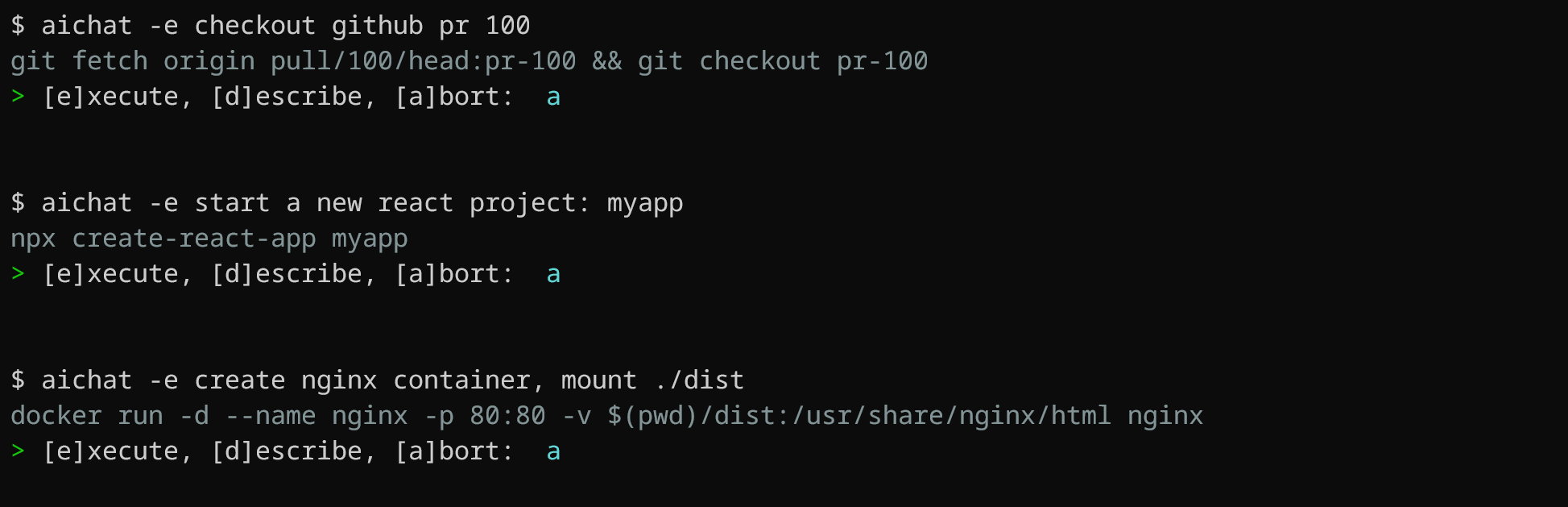
Aichat is aware of OS and `$SHELL` you are using, it will provide shell command for specific system you have. For instance, if you ask `aichat` to update your system, it will return a command based on your OS. Here's an example using macOS:
```sh
aichat -e update my system
# sudo softwareupdate -i -a
# ? [e]xecute, [d]escribe, [a]bort: (e)
```
The same prompt, when used on Ubuntu, will generate a different suggestion:
```sh
aichat -e update my system
# sudo apt update && sudo apt upgrade -y
# ? [e]xecute, [d]escribe, [a]bort: (e)
```
We can still use pipes to pass input to aichat and generate shell commands:
```sh
aichat -e POST localhost with < data.json
# curl -X POST -H "Content-Type: application/json" -d '{"a": 1, "b": 2}' localhost
# ? [e]xecute, [d]escribe, [a]bort: (e)
```
We can also pipe the output of aichat which will disable interactive mode.
```sh
aichat -e find all json files in current folder | pbcopy
```
### Shell integration
This is a **very handy feature**, which allows you to use `aichat` shell completions directly in your terminal, without the need to type `aichat` with prompt and arguments. This feature puts `aichat` completions directly into terminal buffer (input line), allowing for immediate editing of suggested commands.
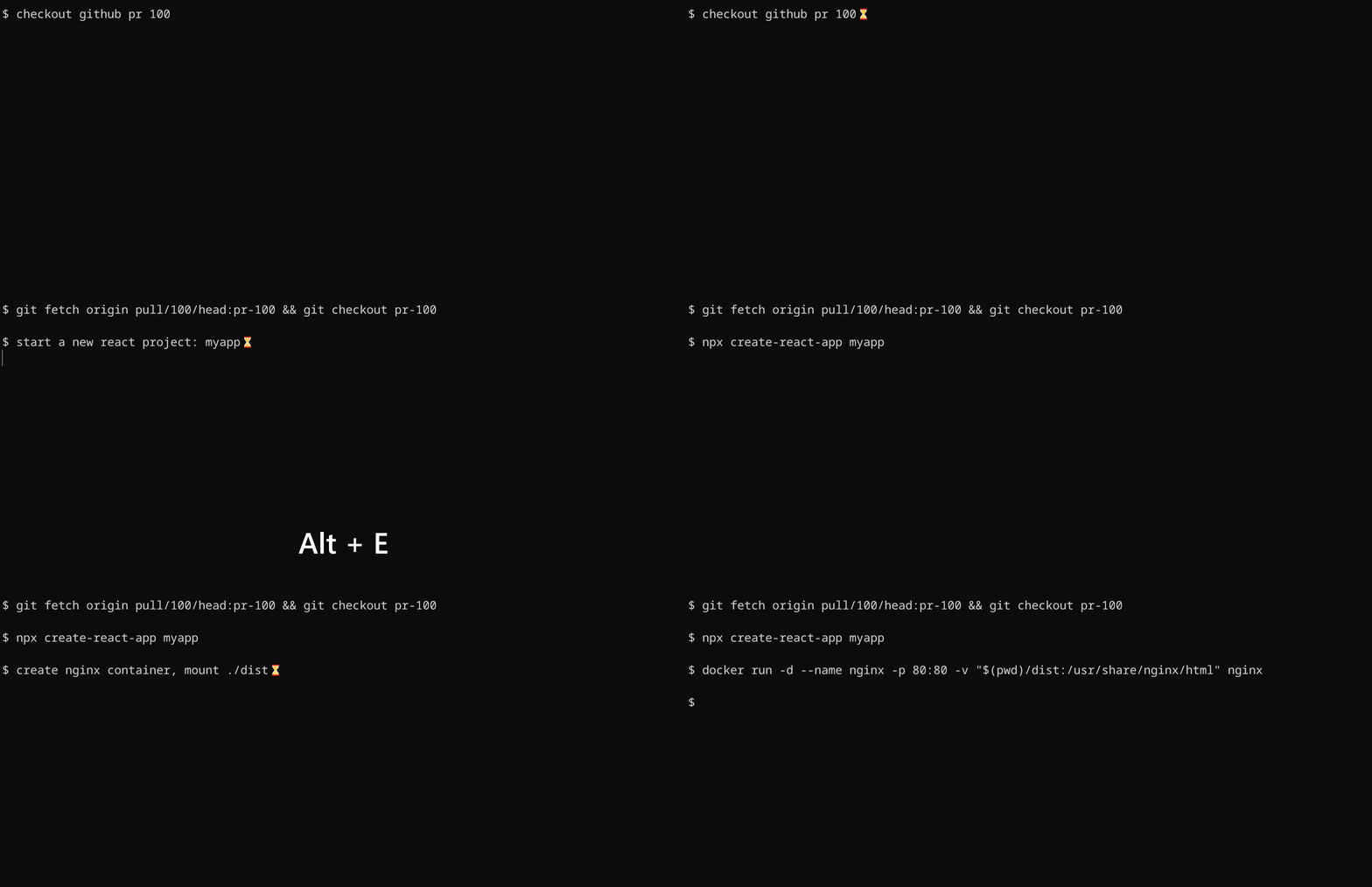
To install shell integration, run the following code:
```sh
sh_ext=bash # possible values: bash, fish, zsh, ps1
sh_url=https://raw.githubusercontent.com/sigoden/aichat/main/scripts/integration.$sh_ext
curl -o aichat-integration.$sh_ext $sh_url
source aichat-integration.$sh_ext
```
After that restart your shell. You can invoke the completion with `alt+e` hotkey.
## License
Copyright (c) 2023-2024 aichat-developers.
Aichat is made available under the terms of either the MIT License or the Apache License 2.0, at your option.
See the LICENSE-APACHE and LICENSE-MIT files for license details.
|
